The Machines That Speak
Understanding What We Call “AI”
By Gene Williams
We have entered a moment where machines write emails, draft stories, answer questions, and speak in voices that feel uncannily familiar. We call this “artificial intelligence,” though the name tells us more about our expectations than the technology itself.
There is a curious habit in every technological age. We name things for what we hope they are, not what they actually do. For decades, the phrase “artificial intelligence” has suggested thinking machines. Entities with awareness, intent, perhaps even emotion. From early science fiction through the optimistic forecasts of the mid-twentieth century, the expectation was clear. One day, machines would think as we do, or perhaps better. That day, despite frequent claims, has not yet arrived.
What we commonly call AI today is something quite different. Modern systems such as large language models (LLMs), image generators, and recommendation engines do not think in the human sense. They don’t possess consciousness, self-awareness, or understanding. Instead, they are highly advanced pattern-recognition systems. They are mathematical architectures trained on vast datasets to predict what comes next. A sentence. An image. A response. Given enough data and computational scale, these systems become super effective at producing outputs that resemble human creativity.
Resemble, but not replicate. That distinction explains both the brilliance and the limitations of what we are seeing unfold.
On one hand, these tools can accelerate work in extraordinary ways. Writers can draft faster. Designers explore more freely. Programmers prototype with greater speed. Researchers surface connections that might otherwise remain buried. In this sense, what we call AI is not a replacement for human intelligence, but an amplifier of it.
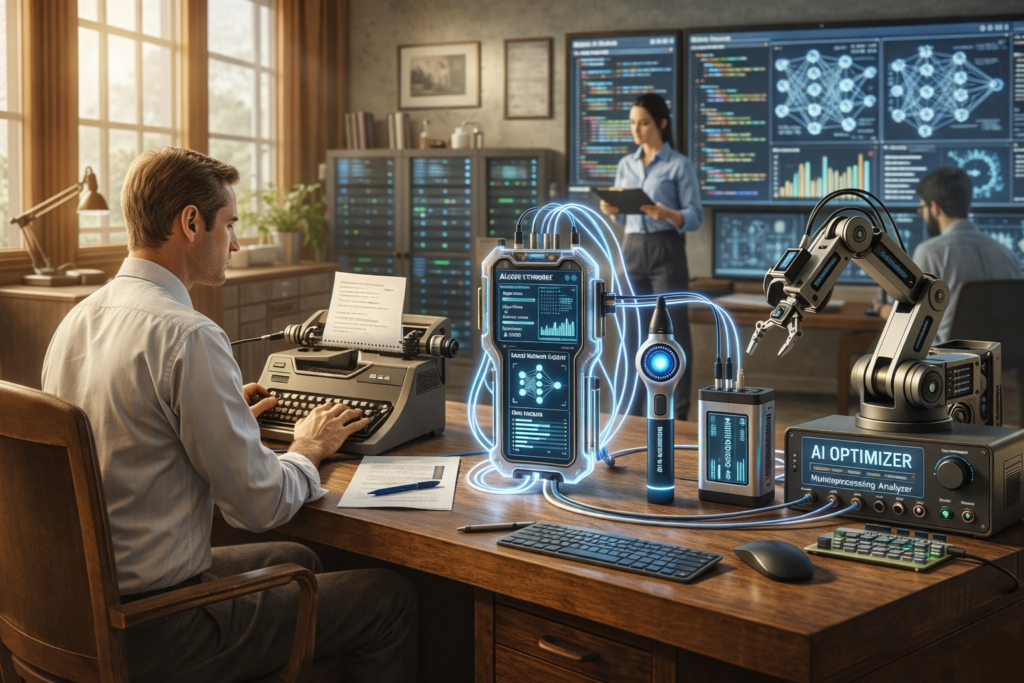
On the other hand, these systems can and do mislead. Because they generate fluent, confident output, they can give the impression of authority even when they are incorrect. They can reproduce biases present in their training data. They can compress nuance into approximation. When used carelessly, they don’t produce intelligence, they produce noise. Polished, persuasive, and sometimes wrong noise, but noise nonetheless.
There is a precedent for this kind of cultural friction. I was part of the music industry when a similar change happened there.
In the music industry, the transition from large analog studios to digital production brought with it a similar divide. Engineers and producers who had built their craft on analog systems argued that digital tools would never match the warmth, depth, or character of tape and hardware. On the other side were those who saw digital as a liberation. Cleaner signal paths, lower cost of entry, greater accessibility, and a dismantling of long-standing gatekeepers.
Both sides were certain. Both sides were, in their own way, incomplete.
Time has a way of clarifying these debates. Today’s music creators widely understand and agree that analog and digital are not opposing truths, but different approaches. Each has strengths. Each has limitations. Many of the most compelling recordings make use of both, combining the tactile character of analog with the precision and flexibility of digital systems.
The lesson is a simple one. New tools do not erase the old. They expand the range of what is possible.
What matters is not the tool itself, but how it is used.
As with any tool of consequence, its value will ultimately be measured not by what it can do, but by the character of those who choose to use it. The cultural moment we find ourselves in is not the arrival of thinking machines. It is the arrival of tools that speak. And I think that changes things…. at least it probably does.
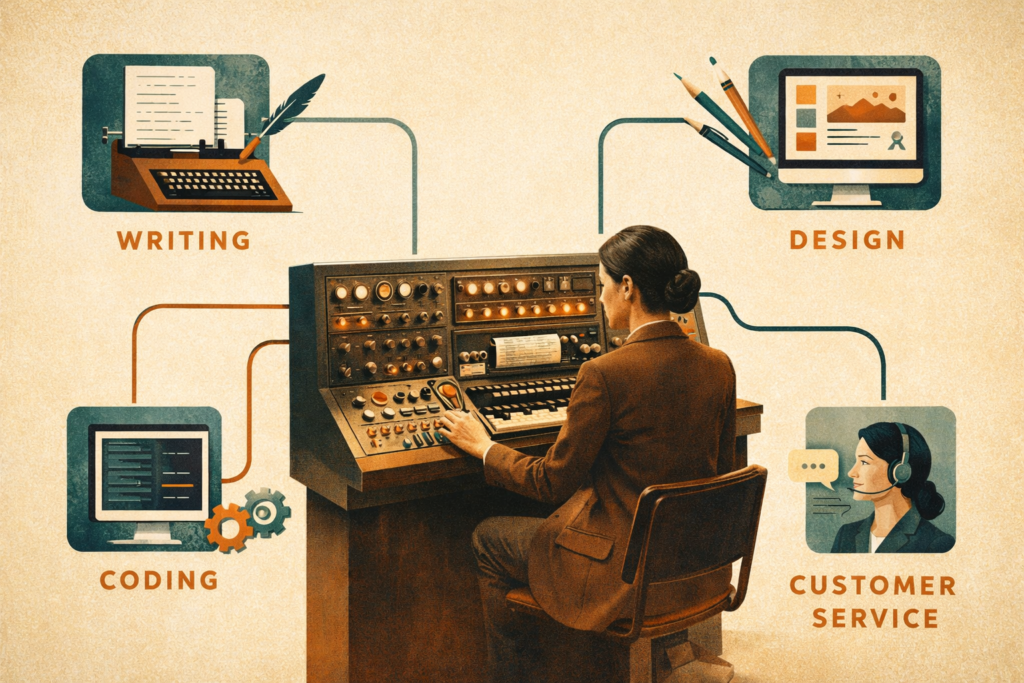
We are already seeing these systems woven into everyday life. Customer service, education, entertainment, journalism, and marketing. Few fields remain untouched. The speed of adoption is not driven by novelty alone, but by utility. These tools save time. They extend capability. They lower the barrier to entry for creative and technical work. That is their real value.
Looking forward, it is possible that true artificial general intelligence may never emerge in the form we once expected. Or if it does, it may arrive so gradually that it is indistinguishable from the tools we already use. A more immediate and perhaps more realistic future is one of integration.
The ship moves space, through a silence so complete it becomes its own kind of pressure. The pilot does not issue commands so much as intentions, and the system translates them into action. It adjusts course, preserves resources, and anticipates failure before it occurs. Not a companion. Not a mind. Something closer to an extension of will. The human provides judgment, intuition, and purpose. The machine provides scale, speed, and recall. Together, they cross distances neither could manage alone.
This is not the story of machines replacing us. It is the story of tools becoming more capable, and of humans learning, slowly and sometimes clumsily, how to use them well. The name “artificial intelligence” may remain. It is a compelling phrase, and difficult to abandon. But it may be more accurate to think of these systems as something else entirely. Instruments of language, probability, and pattern. Powerful, imperfect, and increasingly present.
These “AI” systems ate not minds as we once imagined them, but instruments. And like any instrument, their meaning will be determined by the hands that play them.
Note that all images in this article were generated by ChatGPT