The Power That Was Always Ours
By Leia Dimalanta
In every era of American life, politics has had a way of drifting toward spectacle, toward factions, personalities, and narratives that divide rather than clarify. Yet beneath the noise, the foundation of the system remains unchanged: power in a republic is not granted to the people by politicians. It originates with the people and is only ever loaned to those elected to serve.
That distinction is not philosophical. It is structural. The architecture of the United States was designed so that authority flows upward from citizens, not downward from leaders. Elections, term limits, checks and balances, and the rule of law all exist for one purpose: to ensure that government remains accountable to the governed.
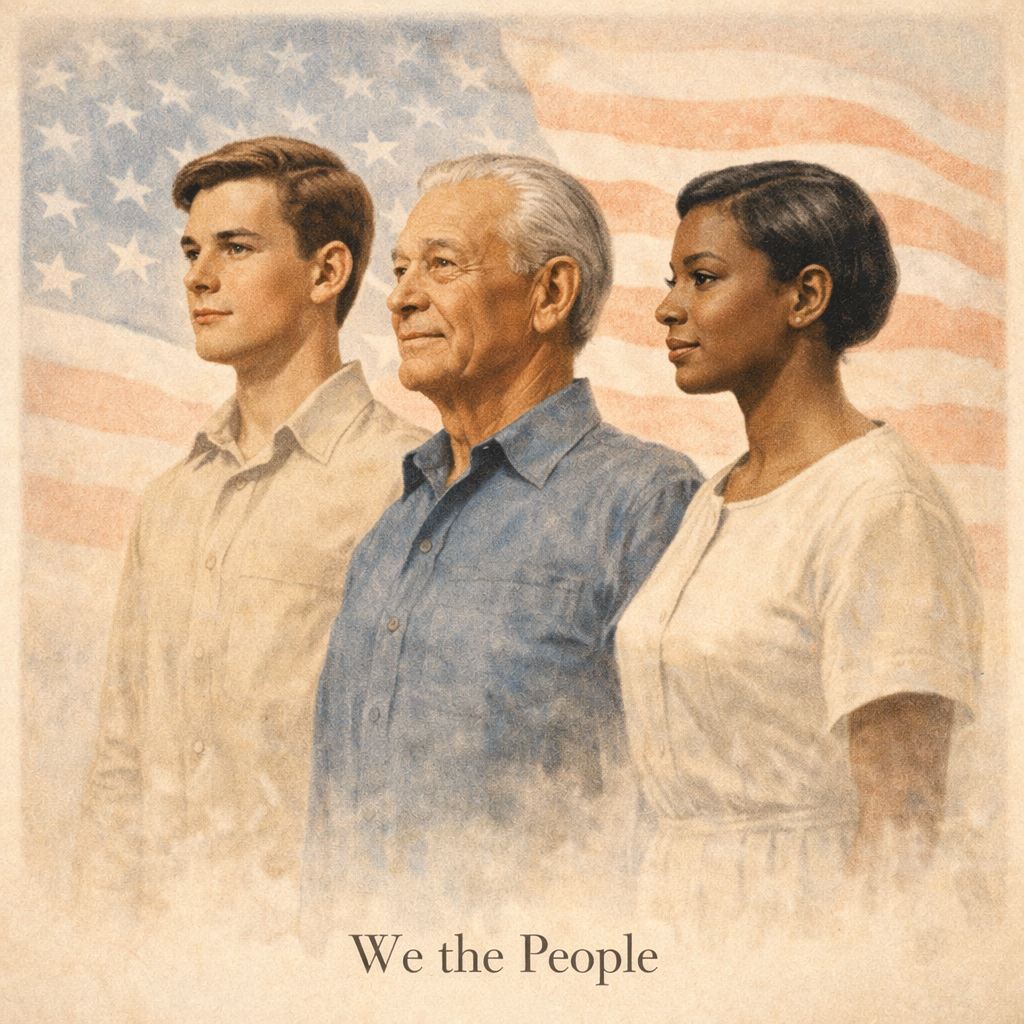
As the nation approaches its 250th anniversary, it is worth reflecting on the word at the heart of its name: United. Not uniform, not identical, not in perfect agreement, but united in purpose. The aspiration was never that citizens would think the same way, but that they would remain bound by a shared commitment to the republic itself. That idea, ambitious in 1776 and still demanding today, remains the central promise of the American experiment.
Over time, however, the relationship between people and government can become distorted, at least in perception. Political discourse becomes dominated by parties rather than principles, and citizens are encouraged to see themselves not as decision-makers, but as spectators choosing between pre-packaged sides. When that happens, the center of gravity shifts away from civic responsibility and toward partisan identity.
Fear plays a central role in that shift. During the depths of the Great Depression, Franklin D. Roosevelt addressed a nation gripped by uncertainty and said:
“The only thing we have to fear is fear itself, nameless, unreasoning, unjustified terror which paralyzes needed efforts to convert retreat into advance.”
That insight remains strikingly relevant. Fear, when amplified, becomes a political tool. It simplifies complex issues into emotional reactions. It encourages citizens to retreat into camps, to distrust one another, and to accept extreme positions in the name of security or survival.
Immigration, economic change, cultural shifts, these are not inherently existential threats. They are policy challenges, requiring deliberation, data, and compromise. But when framed through fear, they become symbols, used to rally support or opposition without the burden of nuance. And that is where the real danger lies, not in disagreement, but in the erosion of rational discourse.

A functioning republic depends on friction. Debate, compromise, and even conflict are not weaknesses. They are mechanisms through which better solutions emerge. But those mechanisms only work when citizens engage with them thoughtfully, rather than reactively. The idea that “we the people” are strongest when united does not mean uniformity of opinion. It means a shared commitment to process over panic, and to long-term outcomes over short-term victories.
Politicians, in this framework, are not meant to be feared or followed blindly. If anything, the opposite is true. They are meant to be held accountable, scrutinized, and, when necessary, replaced. The ballot box is not merely a civic ritual. It is the central lever of power in a democratic republic. When citizens disengage, that lever weakens. When they engage thoughtfully, consistently, and independently, it strengthens.
The health of a nation, then, is not measured solely by its leaders, but by the clarity and resolve of its people. A government that bends the knee to its citizens is not one that reacts to outrage or volatility, but one that responds to informed, persistent, and rational public will. That kind of civic culture cannot be manufactured by policy alone. It requires individuals willing to look beyond slogans, to question narratives, and to participate not as partisans, but as stakeholders and real patriots.
Fear will always be present in political life. It is an easy currency, and it spends quickly. But it is not a stable foundation. The more durable alternative is something quieter and more demanding: an engaged citizenry that understands where power truly resides, and refuses to relinquish it.