Sue Clowes – You have to leave the house if you want to be seen…

By Sue Clowes, photo by Samuel Guerrier
When I graduated from art school in 1979, Margaret Thatcher was the prime minister. Her expansive economic policies led to deindustrialisation, which resulted in factory closures and catastrophically high unemployment. Millions of people waited in line to receive unemployment benefits. 80s chroniclers, and any ideological journalist from that time will swear young people dressed up to avoid the depression and slim employment opportunities. But the truth is, myself and everyone I knew didn’t ‘give a monkey’s’ about who was in power. When you were off your head and dancing like a dervish to Kraftwork’s Schaufensterpuppen, you were hardly thinking about ‘privatization and trade union deregulation.’ The only thing you’d be stressing about was if your pan stick was running down your collar and if your pencilled eyebrows were still there.
It wasn’t going to happen that someone would knock on my door and offer me the job of a lifetime and it was socially unacceptable at twenty-one, to move back in with my parents. The week after I moved out, my mum turned my room into a Tupperware storage office. So, a generation of young people began devising survival strategies and there was a genuine DIY spirit as you had to rely on your imagination to create something that would help you pay your rent and buy food. Different music genres emerged with a special fashion individuality directly linked to each one. Shaved heads, dreadlocks, Doc Martens, winkle pickers, frilly shirts, pink socks etc: Each identity had strict attire. A Rasta would not have a shaved head, and a New Waver would certainly not wear winkle pickers. Every outfit was styled on a budget and worn with a sense of belonging. There was no Instagram to check out how many ‘likes’ you got before stepping out. You merely opened the front door and sashayed onto the street. Nobody cared what people thought. And if society at large shouted insults, you stuck two fingers up, yelled “wankers” at the top of your voice …then ran as fast as you could.
After I graduated from art school, I got a job with a company called Sleeves selling men’s shirts door-to-door. They provided me with a massive bag of shirts and a map and sent me off to the dark corners of East London to knock on doors.
“Hello, I’m from Sleeves. We make affordable drip-dry men’s shirts in a timeless style and…”
The East End was a poor multicultural area, so I got a lot of ‘fuck-offs’ in diverse languages. At the end of the day, after I hadn’t sold a single shirt. I sat on the top floor of a red double-decker bus and looked down at the sad, rainy streets below. People rushed along the pavements, holding newspapers over their heads. The betting shop and Rumberlow’s television rentals were the only shops not boarded up in the area. All of the TVs in the window were stacked one on top of each other, and they were all tuned to the same channel, which showed Maggie Thatcher’s face. The wet puddles on the sidewalk outside reflected a neon blue picture of her. I had an idea: what if I made my own shirts and sold them?
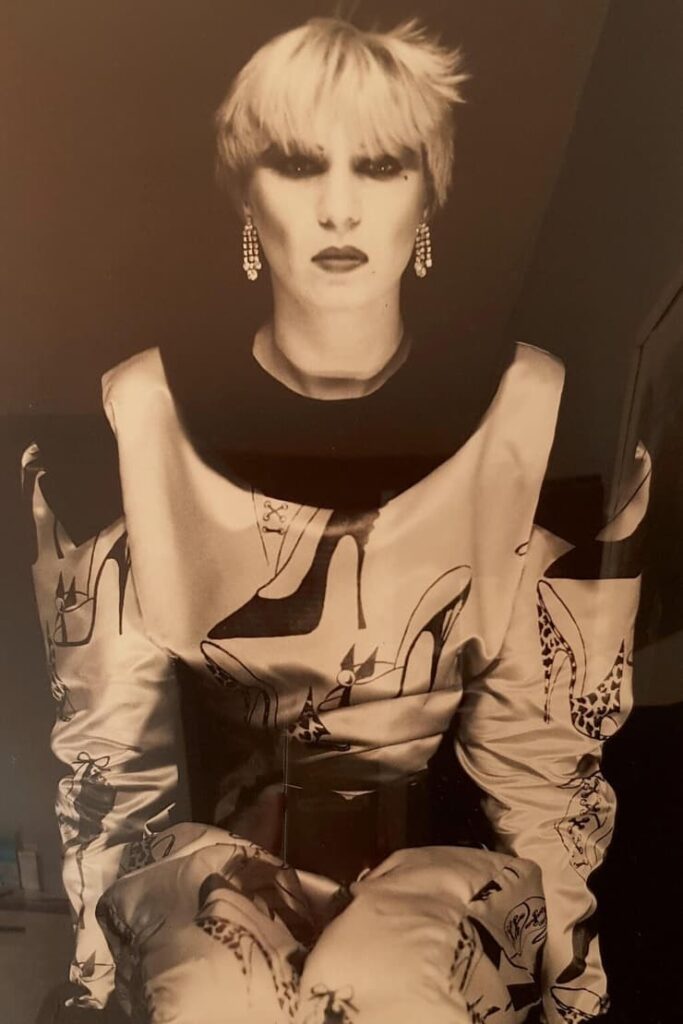
Silkscreen printing was what I learned at art school, and it was all I knew. So that’s how it all began. Let me briefly explain how silkscreen printing works. Fine polyester fabric is stretched tightly over a frame and secured with a staple gun. A light-sensitive emulsion is then coated onto the polyester. This process takes place in a dark room—at home, you can simply close the curtains. Next, you place your stencil and expose it to light. The emulsion hardens wherever the light hits, while the unhardened parts wash away, creating a negative design for the ink to pass through. I remember my first silkscreen print at seventeen, after leaving school; it was a Magritte-style image of a man in a bowler hat in front of a London Underground sign. The most exciting moment is when you pull a squeegee with the ink through the open areas and then lift the frame. The wet ink shimmers on the fabric’s surface before soaking into the cloth. It’s like magic—it’s thrilling.
I was instantly hooked.
Dave Henderson, who had launched his own low-budget record label, shared a derelict basement flat with me in Kentish Town. Although it was meant to be just the two of us in the flat, it felt like half of London was living there. His label, called ‘Dining Out’, was in collaboration with the manager of the Honky Tonk record shop, where there was a rehearsal studio out the back, soundproofed with carpets and egg boxes nailed to the walls. Band members came in and out of our place all hours of the night and day, devoured anything that was remotely edible in the fridge, and then crashed out on the floor. It was a challenge to get to the bathroom navigating your way around drum kits, synthesizers, saxophones, guitars, and Marshall amps. Everyone I knew during that time were happy and full of optimism. They were either in a band or trying to join one, all dreaming of billion-dollar record deals.
There was a massive boom of independent music labels, and some of the best music of this period was DIY singles categorized as Alternative, Indie Rock, New wave, or Ska. Record sleeve design became really creative, with 3D covers and coloured vinyl. Bands got together during that era and played in pubs. I saw Joy Division, XTC, The Jam, The Specials, and many more in the smoke-filled basements of local pubs. Dave printed crazy, colourful covers for the singles he released and we shared a rickety old dining table to print on. There were washing lines zig-zagging all around the flat with record sleeves and t-shirts pegged to them, drying. It was total chaos.
For a silkscreen print to adhere to a t-shirt, the image had to be ironed with a very hot iron. Therefore, I used to get band members to iron for me. In return, I would give them a free t-shirt.
“Do you want a free t-shirt?”
“What’s the catch?”
“You have to iron the image onto the front.”
“How many?”
“If you iron that pile there…” I’d point at about fifty, “I’ll give you one for free.”
Having a constant stream of budding musicians hanging out twenty-four, seven wasn’t all bad. I had a ready-made army of ironers donning my prints, identifiable by the scorch marks. Some of these blokes had never ironed in their lives. Yet there they were, passionately sliding a hot iron over the images. Some were utterly hopeless at it; it would have been quicker to hire a sloth. Still, there they stood, belting out the chorus of their latest song while they worked. In their minds, they were performing for an invisible crowd of topless groupies, arms outstretched, hanging on to their every word. Hence the scorch marks.
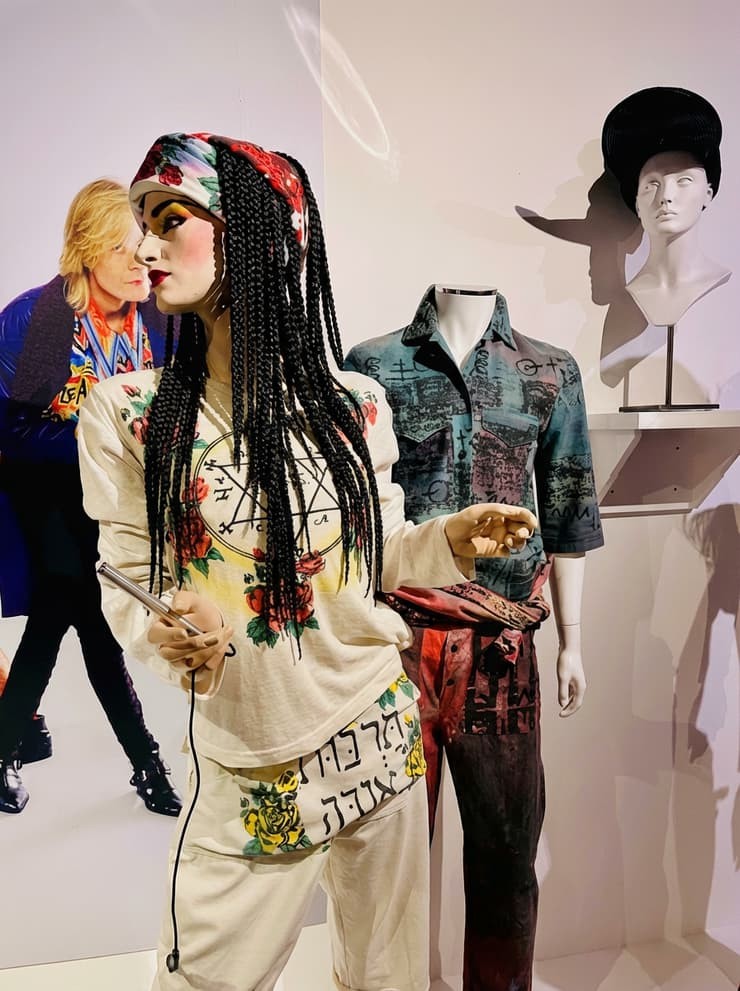
I sold my t-shirts at a stall I rented at Camden Lock Market, a place that attracted an extensive variety of fashion victims hunting down unusual garments. It was a wonderful way to sell my designs. The music of Burning Spear boomed out all day, and the smell of sizzling burgers and the aroma of coffee filled the atmosphere. People on the stalls at Camden Lock didn’t just flog clothes and accessories—they created an identity and a community. At that time, it was a mecca for alternative British youth. In the section I was in, there were sharp fifties suits on rickety rails, a military stall with army fatigues, a whimsical vintage frock stall with hats and jewellery, and, among many other stalls, a hardcore Hell’s Angels emporium of studded leather biker gear. The late seventies and early eighties were a zenith, when what you wore signalled what music, you were currently into. You had the freedom to choose your identity, whether it was as a punk, a teddy boy, a New Romantic, or a hippie. You could track down boots, braces, and porkpie hats if you were into Ska. You could indeed dye your hair fluorescent pink, acquire a tattoo, and have your ears pierced all in one Sunday afternoon.
When I started selling prints in 1979, I called the company “Delicious Serviettes.” I was forever making business cards and leaving them in shops and giving them to strangers on the tube in the hope of selling something or getting a commission. I used to print serviettes and leave them on the seats of the Scala Cinema on Saturday evenings, which was famous for ‘all-night’ horror film marathons. Then on Sunday mornings I’d get the weird and wonderful of London, still sky high on speed, ravenously gobbling down chips at 8 o’clock in the morning and trying everything on in a mad frenzy, asking each other hyper-excited questions like, “What do you think this scarf will look like if I had green hair?” Or, “Don’t you reckon this shirt will go great with my Dr Marten’s boots, fishnets, and pink petticoat?” They became my regulars, and I had the best times setting the stall up ready for them. I became part of this underground lifestyle, mingling among youth cultures.
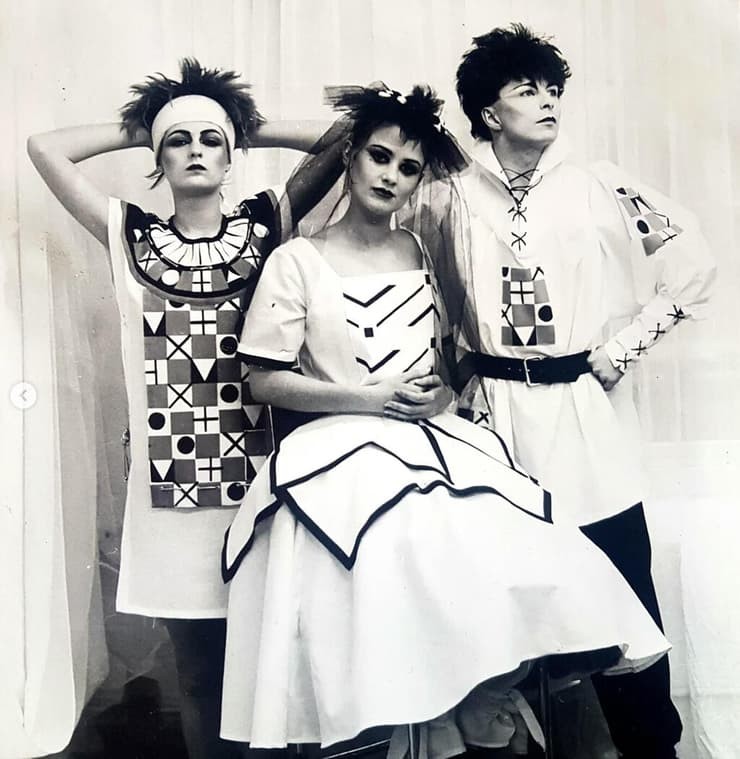
Every week at the market, I’d have a new print to sell. I would come up with an idea on Monday and develop and print it for the following Sunday—budgies, guitars, geometric shapes, on t-shirts and sweatshirts. Then, at the crack of dawn, I would set up my stall. Since I didn’t have a car, I stuffed the clothes into black bin liners and lugged them onto a double-decker bus to Camden. One Sunday, the bus conductor refused to let me on. I had been waiting for an hour in the pouring rain when three buses came barrelling around the corner all at once, as if on cue. Their red paintwork looked almost cartoonish against the miserable grey of the Sunday morning. The colossal bus tires splashed a puddle over the last remaining dry spots on my zebra-print boots, and my orange hair clung to my freezing head as the last bus came to a stop. I threw the two bin liners full of printed t-shirts onto the back platform just as the bus conductor’s grey trouser legs appeared at the top of the staircase. He took one look at the bin bags and yelled,
“Oy. What are you round the twist or summink? You can’t bring rubbish on a bus. We’re not a ruddy dustcart, you know. Bloody punks.”
I desperately needed a car.
In 2012, more than thirty years later, while idly scrolling through YouTube, I came across one of The Cure’s very first broadcasts in Amsterdam, and Robert Smith was wearing one of my early designs, which I had printed and sold at Camden Lock. It had red and black Stratocaster guitars on. I remember him buying it, but I didn’t know at that time he was the singer of the band because shortly after that, he took on the new image with smudged red lipstick and heavy eyeliner. But I remembered him. It was a cold day, and he held a t-shirt up to himself to show his friend, and we all joked as money changed hands. Then I watched as he wove his way through the crowds to the hamburger stall at the entrance. It was cold, and I was standing on a flattened cardboard box stamping my zebra print boots to keep warm. He was young and very clean-cut. They had probably been told by the record producers that they had to get an image. That was what the 1980s were like. Every band had to have an image because records had videos made to go with the music, and fans wanted to dress like their pop idols.
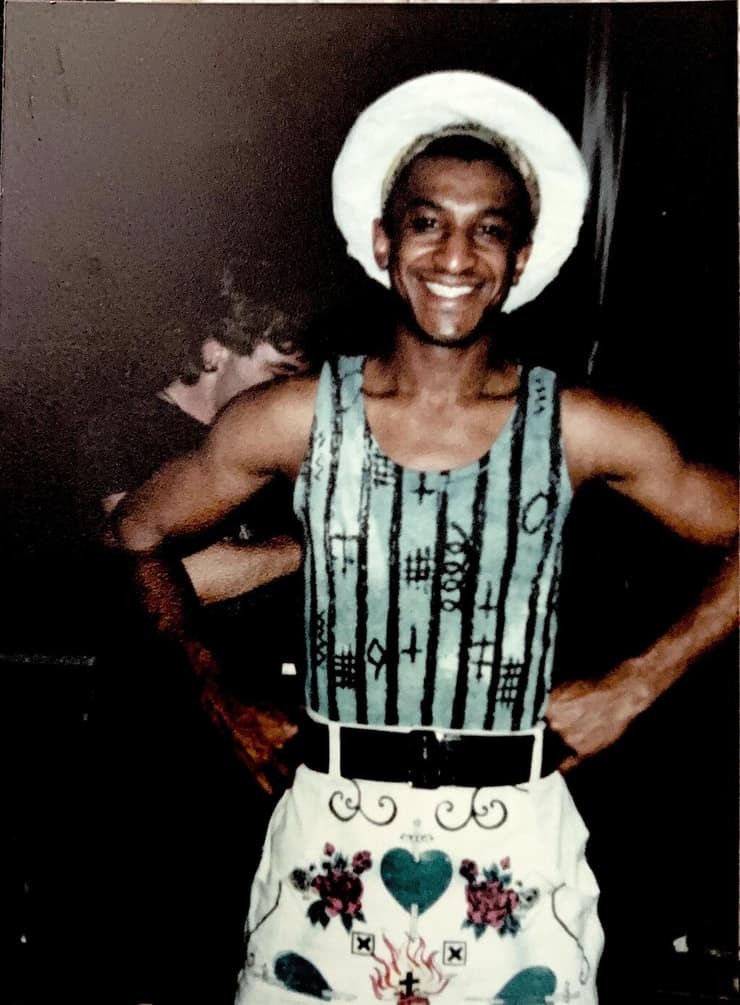
In 1981, I tried my hand at making clothes as vehicles for my prints and began with ties. It would have been easier to make the Hubble Space Telescope than ties. Mine always came out wonky and appeared to have electrostatic forces that made them stand out. But they sold! I bought my fabrics in a shop in Shoreditch. I used to cut through the old fruit and vegetable market of Spitalfields to get there. I remember drizzly grey afternoons where aggressive seagulls, blown off the Thames, stomped in the gutters full of discarded cabbage leaves and squashed fruit. The haberdasher’s shop was on Fournier Street, and in the window, there was every conceivable type of button: three-dimensional profiles of Cleopatra, gilded shank buttons of Roman coins, and sparkling celluloid squares. Buttons used to be fascinating. Behind the counter, from floor to ceiling, were roll upon roll of sequined fabrics, fancy lace, velvets, and brightly coloured taffetas from another era.
There was a lot of racism and homophobia during this period. Skinheads prowled the streets in tribalistic gangs, looking for anyone who didn’t fit. Pakistanis, Indians, Jews, and Gays got beaten up regularly. In the rough area where I lived, there were real neo-Nazis who, for fun, would go out and beat up Pakistani immigrants as a kind of sport.
I had already been working on anti-racist prints when I met Boy George and the newly formed Culture Club. They asked me to work on a special look for them. I loved the idea that all the members of the band were from different cultures and religious backgrounds. George is from an Irish Catholic background; Jon Moss is from a Jewish family; Roy Hay is from an English Protestant background; and Mikey Craig is from the Caribbean culture. Inspired, I created a cultural cocktail of offbeat imagery with religious undertones that reflected the unique backgrounds of each band member, celebrating their diverse heritages through vibrant designs and motifs. The final ‘Culture Collection’, as I have come to refer to it, with vivid prints and patterns, had an overriding message: a celebration of diversity, appreciation of each other’s cultures, and mutual respect. The garments were sold in a shop called The Foundry in a back lane near Carnaby Street, where George ran the shop. Culture Club was photographed wearing the collection in The Face magazine, and George and I dressed up and posed outside the shop. When ‘Do you want to hurt me?’ in October 1982 became a UK, No.1 single for three weeks, the music, the look, and the ideology took off in a big way. I was twenty-two at the time, George; now Boy George was nineteen. We both believed that connecting all cultures was a wonderful idea. I never thought that taking a symbol of a particular religion was something to avoid, as I believed it could promote understanding and unity among different cultures. I wanted to create harmony. Let’s be friends; let’s dance together. It was naive, but wouldn’t it be nice if the world worked that way?
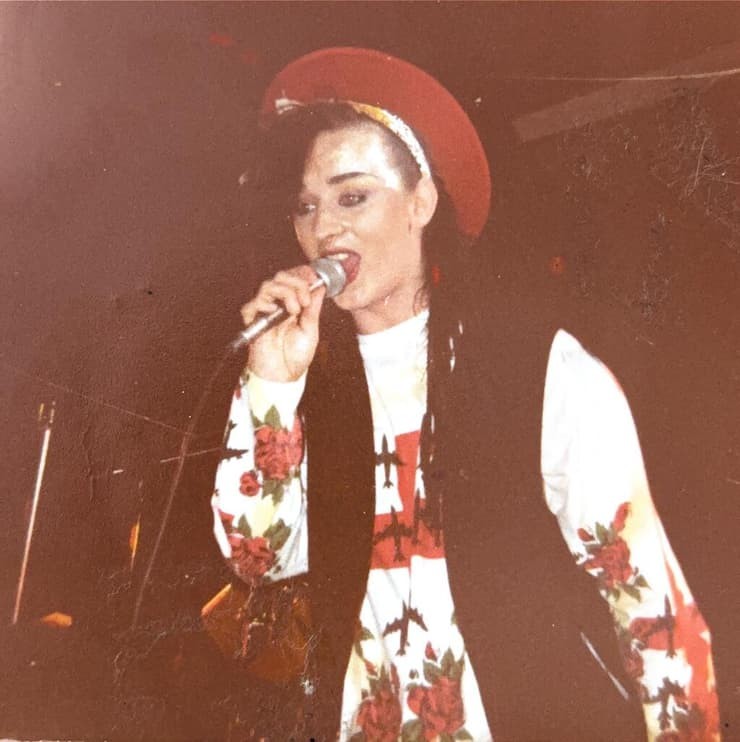
Many musicians began wearing pieces from my collections for photo shoots and record sleeves, some visiting my studio or sending stylists. Tony Hadley and Steve Norman from Spandau Ballet wore my 1985 collection in the video for ‘Round and Round.’ Other artists and groups that wore my pieces included INXS, Bananarama, Jonny Slut from Specimen, Alison Moyet, Jennie Mathias from The Belle Stars, Jody Watley from Shalamar, Depeche Mode, Jermaine Stewart, The Psychedelic Furs, Fàshiön, Kylie Minogue, Toyah, Nina Hagen, Kim Wilde, and Dave Stewart of Eurythmics. I also designed garments for the legendary industrial band SPK formed by Graeme Revell, the Hollywood film score composer. I was thrilled in May 2024 when Miss Vanjie, a contestant on RuPaul’s Drag Race, wore one of the ‘Sex in Heaven’ t-shirts I designed for Supreme on the show. She looked really sexy and reached the grand finale and placed in the top three.
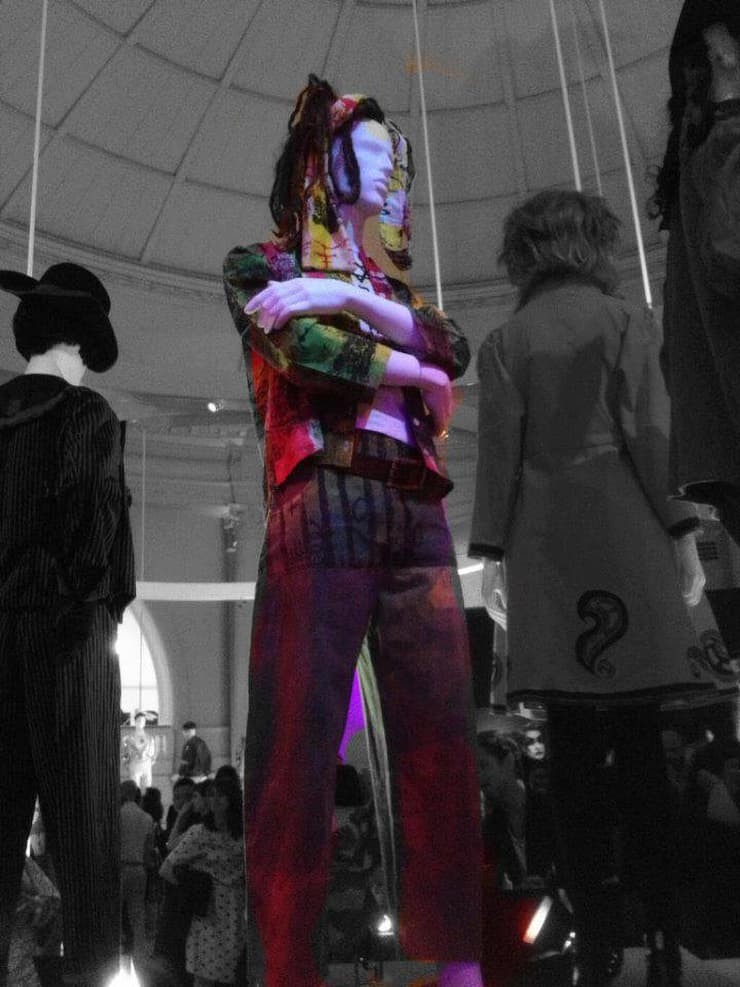
In 1982 I relocated to another basement workshop beneath the streets of East London and purchased an old 1953 VW Beetle. Hurray! Basements were always cheap because they were inevitably damp. This Dickensian dump featured what seemed to be London’s electricity control system mounted on one wall, complete with meters and switches. Swathes of underground cables snaked out of the wall, drooped for a few yards, then mysteriously disappeared back into the damp brickwork, only to reappear a few yards further on.
One afternoon, there was a knock at the door, and I climbed the narrow, precarious open-tread stairs to be confronted by a ghostly white teenager with high cheekbones and a striking, vampiric appearance. His Death Hawk hairstyle was in its embryonic stage: still evolving, not yet hatched to its full goth potential.
“Hello. My name is Jonny. Have you got any jobs going?”
“What can you do?”
“Ermmmmm, print, hem, make tea…”
“Okay, sounds good.”
I already had three people working for me, cutting and machining, but I took him on. He was a total inspiration for my new 1983 collection called Flesh and Steel. In contrast to the Culture Club collection, I printed silver crosses on jackets and trousers, created bustiers adorned with birds, and designed printed leather belts, studs, and chains. Jonny assumed the role of a house model, fetched my lunchtime taramasalata sandwiches, brewed tea, printed, and operated the tumble dryer.
His best role was greeting American department store buyers as they carefully descended the open-tread stairs to the basement, power dressed to the nines in huge padded shoulders, rhinestone sunglasses, and kitten heels. We would all look up the stairs, watching their progress. When the store buyers spotted Jonny, who had transformed into the Goth of all Goths, waiting at the bottom, they had to brave it out; they couldn’t turn back halfway down the stairs because it was too narrow.
“Do you want a cuppa tea?” he’d ask cocking his head to one side like a parakeet.
Jonny joined the group Specimen, a pioneering glam rock band, famously associated with the Batcave club. With his fabulous, striking Mohawk, which reached a foot high, he became the infamous Jonny Slut, the keyboardist and an icon of the goth movement. I had orders from all over the world for the silver-print trousers he wore. In 2023, I sold a pair at a London auction for $12,000 for an exhibition in Museo de la Moda, Santiago, Chile.
I received a message on Instagram:
“Good job I popped in that day looking for work!” Jonny S.
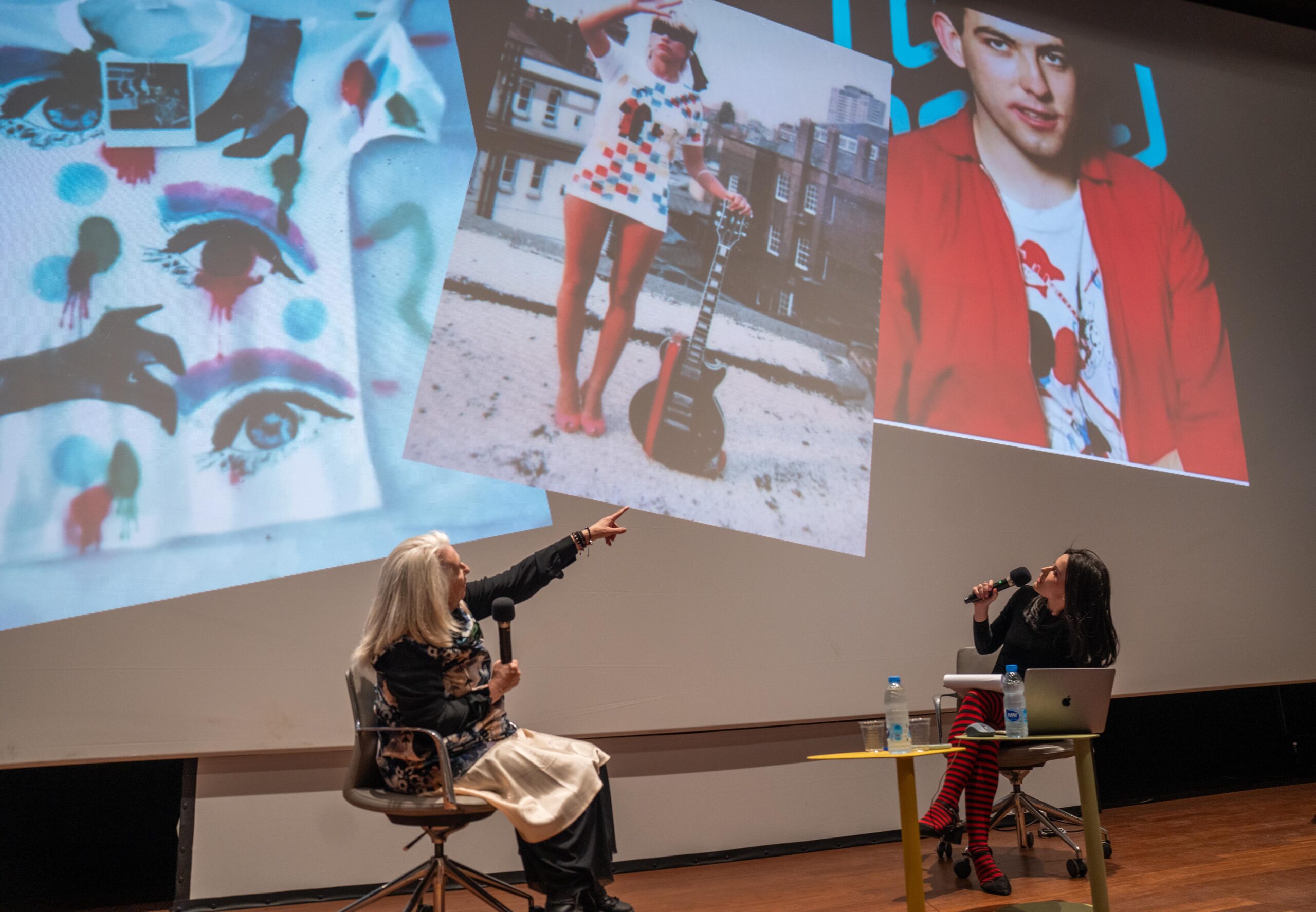
Anecdotes from a book to be published by Sue Clowes. “You have to leave the house if you want to be seen.”