The California Illusion
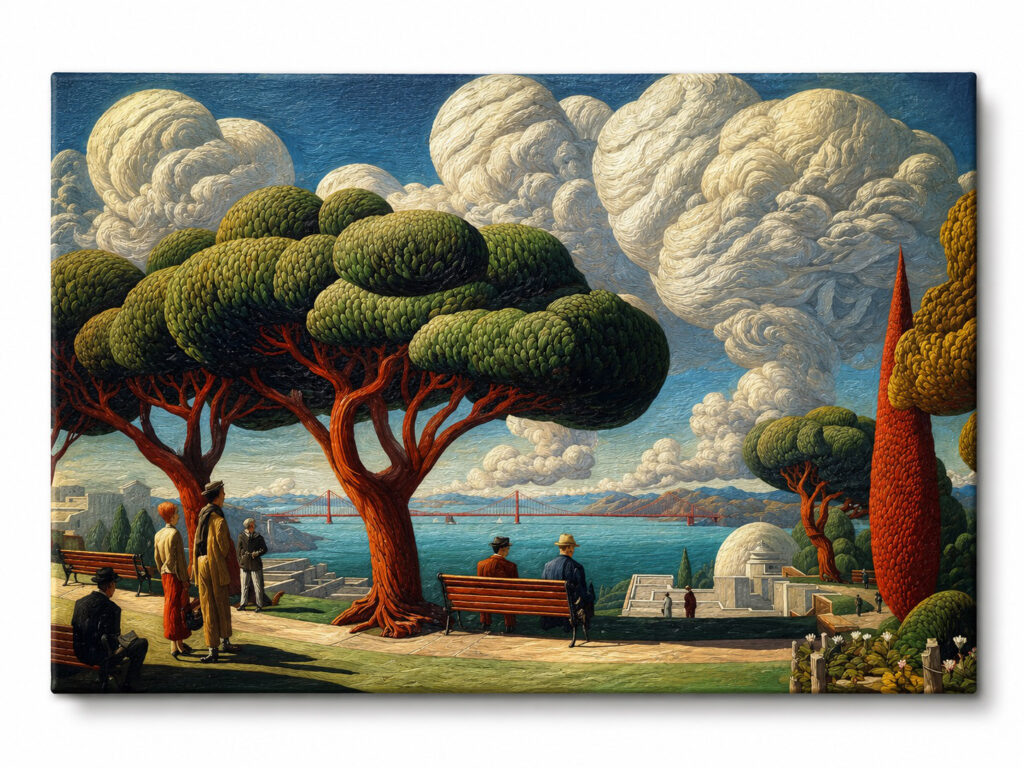
Easton Cain, Emerald Thinker Gallery, and the art world’s most quietly compelling mystery
By Simone Bell
Before sunrise, Northern California has a way of disguising itself. The hills disappear beneath a low ceiling of fog, eucalyptus trees become silhouettes, telephone poles dissolve into pale light and the landscape seems undecided, suspended somewhere between memory and invention. Nothing announces itself. Everything waits.
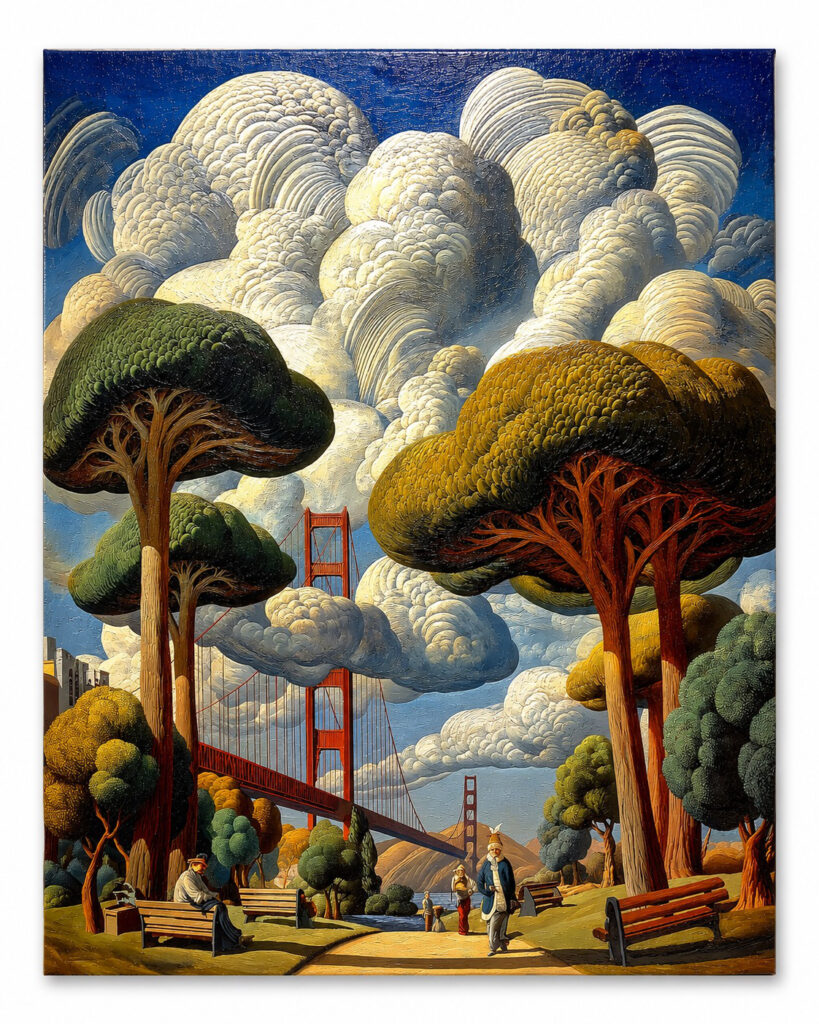
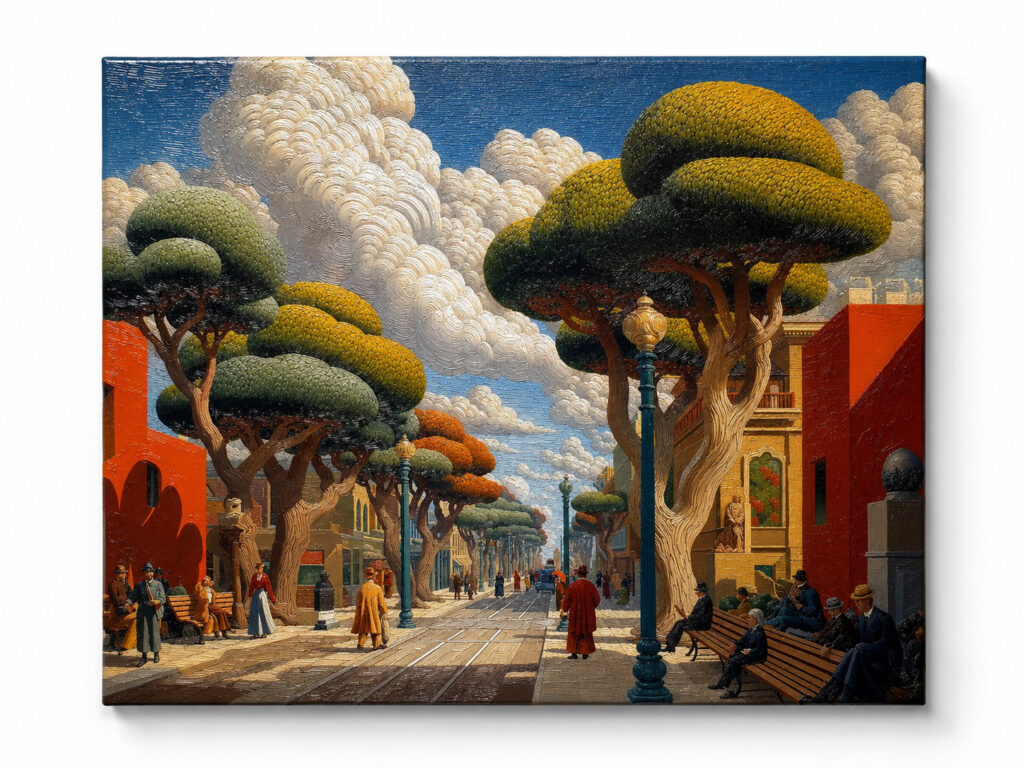
It is in places like these that myths begin — with whispers and without spectacle. Then, almost without warning, came Easton Cain. There was no singular moment, no dramatic unveiling, his paintings simply began appearing — first on the screens of collectors, then across feeds and timelines, possessing a curious contradiction: they looked almost digitally rendered, yet were unmistakably oil paintings executed entirely by hand. Viewers instinctively leaned closer, searching not for brushstrokes but for pixels.
They never found them. Because they were looking at oil paint. Cain’s work felt simultaneously familiar and strangely disorienting. He had resurrected the visual language of American Regionalism — not as an exercise in nostalgia, but as something unmistakably contemporary. Where Grant Wood found dignity in Midwestern farms and Thomas Hart Benton discovered rhythm in the American interior, Cain turned his attention westward. California marshes. Weathered diners. Eucalyptus groves. Quiet suburbs. Freeways cutting across golden hills. Places millions of people passed each day without noticing until they appeared on canvas with almost devotional clarity. The paintings didn’t romanticize California, they slowed it down.
Behind that ascent stood Emerald Thinker Gallery — and the gallery itself had begun attracting a quieter, more persistent fascination. There is no physical address, nor a velvet rope, no white walls, no carefully lit pedestal. Emerald Thinker exists entirely online, which in the traditional art world should have been a liability. Instead it became a kind of mystique. Without the geography of a Chelsea storefront or a Melrose address to anchor it, the gallery occupied something harder to define — a curatorial presence felt more than located. Discovery happened quietly, one shared image at a time, until the gallery seemed less like a destination than a recurring encounter.
What distinguished Emerald Thinker further was infrastructure that had no obvious precedent in the gallery world. A provenance system — custom-built, collector-facing software discussed in hushed tones in acquisition circles — treated each painting not merely as an object but as a living record. Ownership history, exhibition documentation, authentication data: all of it preserved in architecture designed to outlast the transaction itself. In an art market still largely dependent on paper certificates and institutional memory, it struck observers as either visionary or excessive, possibly both.
Then came the question no one could quite answer: who built it?
The ownership of Emerald Thinker has never been formally announced. No press releases, no founder profile in a trade publication, what circulates instead are the kind of rumors that travel in the spaces between verified facts — suggestions of backgrounds not in fine art but in digital marketing and film. An unlikely combination by any conventional measure. Performance data and storyboards. Conversion rates and cinematography. The language of audience-building imported into a world that had always prided itself on resisting such calculations.
And yet the results are difficult to argue with. The campaigns feel less like promotion and more like narrative. The releases feel less like sales events and more like chapters. Whatever the background of the people behind it, they appear to understand something essential: that in the attention economy, a painting is not merely a painting. It is the beginning of a story someone decides to carry home.
Around the same time, another phrase began appearing with increasing frequency.
The Analogous Art Movement.
Its message was remarkably simple: make things slowly. As artificial intelligence accelerated image production and algorithms rewarded speed above all else, painters began celebrating process instead of immediacy. Brushes replaced styluses. Pigment replaced prompts. Hours replaced seconds. Millions watched artists devote weeks to a single surface.
To many, it looked like the natural evolution of contemporary art. To others, it looked almost too organized. Anonymous posts began appearing — on forums, in comment sections, buried inside threads that vanished within hours. They described private gatherings somewhere in Northern California. Invitations that could not be requested, only received. One account, since deleted, described arriving at a house with no visible address, where paintings covered every wall and no one offered their last name. Artists, collectors, technologists, and patrons gathering quietly, beyond the reach of cameras.
No credible evidence ever emerged. The accounts contradicted one another, yet they refused to disappear. History offers no shortage of precedent. The Impressionists were dismissed before they were celebrated. The great American Regionalists were accused of romanticizing a nation that no longer existed. Nearly every artistic shift has first appeared improbable, then controversial, then inevitable.
Extraordinary influence has always attracted suspicion — perhaps because we find it easier to believe in secret architecture than in the simpler truth of singular talent arriving at exactly the right moment. Maybe Emerald Thinker simply recognized something before anyone else did. Maybe Easton Cain is precisely what he appears to be. Or maybe the real mystery was never about meetings or movements at all.
In an age where nearly every image is generated, filtered, optimized, and forgotten within seconds — a single carefully painted landscape has managed to make people stop scrolling.
To look.
To wonder.
To remember what it felt like when something was made slowly, by hand, with the full weight of human attention behind it. In a world built by algorithms, that has become so rare it now resembles a miracle.
And miracles, as history has always shown us, have a way of attracting believers — and conspiracies — in equal measure.
https://www.instagram.com/emeraldthinker
https://www.facebook.com/Emeraldthinker?mibextid=wwXIfr
https://www.linkedin.com/company/emerald-thinker
http://www.tiktok.com/@emeraldthinkerart